What if one of the most beautiful revolutions in women’s watchmaking fits inside a movement just 11.85 millimetres across? The Blancpain Ladybird Legacy exhibition, open in Paris from 8 to 23 October 2026, tells that story through nearly thirty historical creations from the manufacture’s archives.
At its heart is Betty Fiechter, who became co-owner of Blancpain in 1933 and ran it alone from 1939. Under her, the house mastered miniature mechanical movements and, in 1956, launched the Ladybird. The Blancpain Ladybird Legacy marks that history and the Ladybird’s 70th anniversary.
This guide covers the exhibition, the woman behind it, the engineering of the tiny R52/R55 calibre, the new Lady B, the Marilyn Monroe connection and what is next on the tour.
Blancpain Ladybird Legacy at a Glance
| Exhibition | Blancpain Ladybird Legacy |
| Dates | 8 to 23 October 2026 |
| Location | The new Blancpain boutique, 11 rue du Faubourg Saint-Honoré, Paris (8th arrondissement) |
| On show | Nearly thirty antique watches, jewellery pieces and precious objects from the archives |
| Central figure | Betty Fiechter, co-owner from 1933 and sole head from 1939 |
| Landmark watch | The 1956 Ladybird, with the 11.85 mm R52/R55 calibre |
| Anniversary | 70 years of the Ladybird, marked in 2026 by the new Lady B |
| Next stops | Tokyo (17 to 25 October 2026) and Seoul (11 to 15 November 2026), with more planned for 2027 |
Why Blancpain Ladybird Legacy Honours Women’s Watchmaking
The history of fine watchmaking is usually told through chronographs, diving watches and aviation timepieces. A parallel story ran alongside it: women’s watches and miniature mechanical movements.
That story mattered to technical research. A very small mechanical watch needs special solutions to arrange the gears, keep the movement reliable and preserve a useful power reserve. The Blancpain Ladybird Legacy puts that story on display. It shows a conviction that spans decades: a women’s watch is not simply a piece of jewellery that tells the time, but a true creation of fine watchmaking.
Inside the Blancpain Ladybird Legacy Exhibition in Paris
The exhibition is held in Blancpain’s new boutique at 11 rue du Faubourg Saint-Honoré. The Blancpain Ladybird Legacy presents antique watches, jewellery pieces and precious objects that the manufacture has preserved in its archives. Together, they show how proportions, shapes and uses changed over time.
Some pieces look like traditional wristwatches. Others lean towards jewellery, with the mechanism almost invisible. The display shows how a technical advance can change the look of an era.
Nearly Thirty Creations: From Wristwatches to Jewellery
As calibres shrank, new forms became possible: rigid bracelets, watches built into jewellery, sculptural compositions and stone-set creations. That freedom explains why miniaturisation holds such an important place in Blancpain’s history.
Betty Fiechter: The Woman Who Shaped Blancpain
Berthe-Marie Fiechter, known as Betty, was born in 1896 in Villeret, Switzerland, in an environment close to the watch industry. She joined Blancpain as a teenager. The company was then led by Frédéric-Émile Blancpain, of the founding family’s seventh generation.
She gradually learned how the business worked and took on responsibility for workshop operations and commercial management. Her path did not follow family succession. It was built on professional progress inside the factory. It is impossible to understand the Blancpain Ladybird Legacy without her.
From 1933 to 1968: A Rare Career in Swiss Watchmaking
When Frédéric-Émile Blancpain died in 1932, the company’s future became uncertain. Betty Fiechter and André Léal, the sales director, decided to buy the factory. They did so in the middle of the Great Depression.
In 1933, she became co-owner. After Léal’s death in 1939, she took sole charge. Blancpain presents her as the first woman to lead a major Swiss watchmaking company, and her rise came before Swiss women won the federal vote in 1971, 38 years after she became co-owner, by our count. She retired in 1968, after 35 years at the top of the company, again by our count, leaving a watchmaking culture of which the Ladybird is one of the clearest examples.
An Industrial Vision for Women’s Watchmaking
Fiechter saw early that women’s watches could become a real field of mechanical research. Fashion at the time favoured small timepieces. For watchmakers, that was a challenge: they had to fit a reliable mechanical movement into a tiny space without losing precision or strength.
Under her, Blancpain built a specific skill in miniature movements. That skill shaped design for years, producing watches that combined precise mechanics, stylistic freedom and jewellery-level refinement.
The 1956 Ladybird: A Watch the Size of a Jewel
In 1956, Blancpain launched the first Ladybird, also known as the Ladybird Bullet. Its case is small, spherical and almost sculptural, and its simplicity contrasts with the more decorative jewellery watches of the time. Its real distinction is inside.
The R52/R55 Calibre: 11.85 mm of Engineering
The movement in the first Ladybird measures 11.85 millimetres in diameter. According to Blancpain’s archives, it remains the smallest round mechanical movement ever mass-produced.
That wording matters. It separates the R52/R55 from experimental creations, non-round movements and one-off prototypes. The achievement lies not only in designing a tiny calibre, but in making it in numbers and fitting it into working watches. In 1956, that opened a new field of design.
How the Ladybird Miniature Movement Works
Two technical choices explain the R52/R55.
An extra wheel in the gear train. In a classic mechanical movement, the gear train carries energy from the mainspring barrel to the escapement. Blancpain added a fifth wheel. That arrangement adapts the transmission of energy to the very small size of the calibre.
Shock protection for the balance wheel. The balance wheel helps regulate the watch’s timekeeping. Fitting shock protection into such a small movement is hard, but Blancpain kept it to make the mechanism more robust.
Together, these choices show that miniaturisation is not just making parts smaller. It means rethinking how they are arranged and how they work.
Where Miniature Watchmaking Meets Fine Jewellery
In the 1950s and 1960s, women’s watches sat between two worlds. They were still instruments for measuring time, but they were also jewellery, with proportions, materials and decoration central to their appeal.
A smaller movement gave designers more freedom: original cases, decorative bracelets and watches built into jewellery. The archives show curved lines, rigid bracelets, rounded volumes and designs inspired by nature, set with precious materials and stones. The mechanism still had to run precisely. This meeting of fine watchmaking and fine jewellery is one of the richest areas of women’s watchmaking, and it shows that a mechanical complication is not the only measure of excellence.
Why a Women’s Watch Is Not a Men’s Watch in Miniature
For a long time, women’s collections were defined by diameter, colour or gem-setting. The Ladybird story offers another approach. A women’s watch can need its own mechanical architecture. It can be designed from the start around a particular calibre and its own aesthetic vision. It is then a watch in its own right, not a smaller version of an existing model. That idea still matters to modern makers who want to combine complications, comfort, proportions and style.
Lady B 2026: The Blancpain Ladybird Legacy Continues
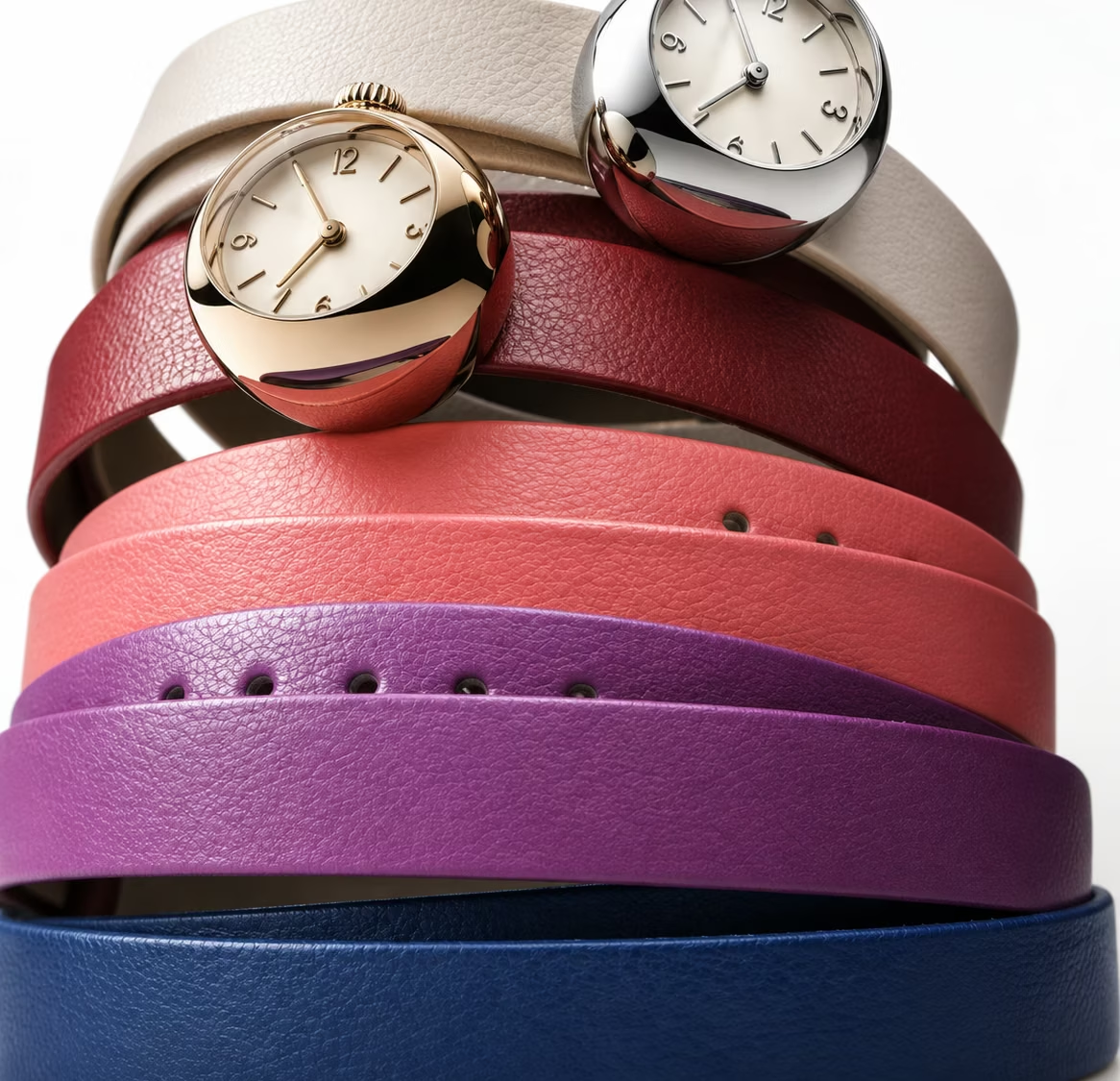
In 2026, Blancpain marks the Ladybird’s 70th anniversary with the Lady B, inspired by the spirit of the 1956 Ladybird Bullet. The house is clear that it is not a faithful reissue. It is a contemporary reading of the original’s architecture, with a similar aim: a mechanical movement inside an object about the size of a piece of jewellery.
The case is spherical, 19 mm in diameter and 13.2 mm thick, with a stated volume of 2.9 cm³. The bracelet passes directly through the case, with no visible lugs, which gives the watch its sculptural look. It comes in stainless steel and 18-karat red gold. A double-wrap calfskin leather strap adds to its jewellery-watch character.
Lady B Specifications: Caliber 615 and a 19 mm Case
| Feature | Blancpain Lady B 2026 |
|---|---|
| Movement | In-house automatic caliber 615 (also written calibre) |
| Movement diameter | 15.70 mm |
| Movement thickness | 3.90 mm |
| Components | 180 |
| Jewels | 29 |
| Frequency | 3 Hz |
| Power reserve | 38 hours |
| Case diameter | 19 mm |
| Case thickness | 13.2 mm |
| Stated volume | 2.9 cm³ |
| Materials | Stainless steel or 18-karat red gold |
| Decoration | Bridges with Côtes de Genève |
These figures come from Blancpain’s official technical presentation. The caliber 615 is not the 1956 R52/R55. The Lady B carries on the philosophy of miniaturisation with a different mechanical design.
Two comparisons are ours. The 615 is 3.85 mm wider than the 11.85 mm R52/R55, about 32% larger. And 3 Hz equals 21,600 vibrations per hour.
Marilyn Monroe and Blancpain: The Diamond Cocktail Watch
The story of Blancpain’s women’s watches has a cultural side, too: Marilyn Monroe. The actress owned a Blancpain cocktail watch set with diamonds. Its exact provenance remains somewhat uncertain. Blancpain bought it at auction in 2016 and showed it publicly in New York in October 2019, during Timeless Elegance.
The case is rectangular and made of 950 platinum. It is set with 71 brilliant-cut diamonds and two marquise-cut diamonds. Inside is a miniature baguette movement, the FHF 59. Blancpain estimates it was made between the late 1940s and the early 1950s. It is a different watch from the 1956 Ladybird Bullet, and the two belong to separate technical and design histories.
Ladybird Tribute 2026: Seven Pieces for Marilyn
To mark 100 years since Marilyn Monroe’s birth, Blancpain unveiled a capsule collection called Ladybird Tribute on 1 June 2026. It has seven unique pieces, each linked to a letter of her name. It reworks the jewellery watch in a contemporary way, inspired by the piece the actress owned, and it complements the history told in the exhibition without replacing it.
The New Boutique at 11 Rue du Faubourg Saint-Honoré
Paris suits the show. For decades, the French capital has been one of the world’s main centres of luxury, home to high jewellery houses, watch boutiques and historic brands, where creativity and heritage count for a great deal.
The Blancpain Ladybird Legacy is held in the manufacture’s new boutique, which opened on 24 July 2026. It sits at 11 rue du Faubourg Saint-Honoré, in the 8th arrondissement, and covers 120 m².
Key Dates: From 1896 to 2026
| Year | Event |
|---|---|
| 1896 | Betty Fiechter is born in Villeret |
| 1932 | Frédéric-Émile Blancpain dies |
| 1933 | Betty Fiechter becomes co-owner of Blancpain |
| 1939 | She takes sole control after André Léal’s death |
| 1956 | The first Ladybird, with the R52/R55 calibre |
| 1968 | Betty Fiechter retires |
| 1971 | Swiss women win the federal vote |
| 2016 | Blancpain acquires Marilyn Monroe’s watch at auction |
| 2019 | The watch is shown in New York |
| 1 June 2026 | Ladybird Tribute unveiled |
| 24 July 2026 | Paris boutique opens |
| 8 to 23 October 2026 | Ladybird Legacy in Paris |
Where Blancpain Ladybird Legacy Travels Next
After Paris, the exhibition continues its international tour. Blancpain lists Tokyo from 17 to 25 October 2026 and Seoul from 11 to 15 November 2026, with more stops planned for 2027. New York and Shanghai are also named among the cities on the route.
The Tokyo dates overlap with the last week in Paris, so confirm with Blancpain which pieces appear in each city. The Blancpain Ladybird Legacy schedule may change.
Blancpain Ladybird Legacy: Frequently Asked Questions
What Is the Blancpain Ladybird Legacy Exhibition?
It is a heritage exhibition that highlights the role of women in Blancpain’s history. It brings together nearly thirty historical creations, including vintage Ladybird watches and precious objects.
What Are the Dates for Blancpain Ladybird Legacy in Paris?
The exhibition runs from 8 to 23 October 2026 at the Blancpain boutique at 11 rue du Faubourg Saint-Honoré, in the 8th arrondissement of Paris.
Who Was Betty Fiechter?
Betty Fiechter was a Swiss businesswoman, born in 1896, who became co-owner of Blancpain in 1933. After André Léal’s death in 1939, she ran the company alone. She played a major role in the development of miniature mechanical movements and women’s watches.
When Was the First Blancpain Ladybird Created?
Blancpain presented the first Ladybird in 1956. It used the R52/R55 calibre, which measures 11.85 mm in diameter.
Why Is the 1956 Ladybird Movement Exceptional?
Blancpain presents the R52/R55 as the smallest round mechanical movement ever mass-produced. Its design combines a distinctive gear train with shock protection for the balance wheel.
What Is the Difference Between the 1956 Ladybird and the Lady B?
The 1956 Ladybird Bullet uses a miniature mechanical movement 11.85 mm in diameter. The 2026 Lady B is a contemporary reinterpretation with the automatic caliber 615 and a 19 mm spherical case.
Did Marilyn Monroe Own a Blancpain Watch?
Yes. She owned a Blancpain jewellery watch in platinum and diamonds. Blancpain acquired it in 2016 and showed it in New York in 2019. It inspired the Ladybird Tribute capsule collection unveiled in June 2026.
Will Blancpain Ladybird Legacy Travel to Other Cities?
Yes. Tokyo is scheduled for 17 to 25 October 2026 and Seoul for 11 to 15 November 2026, with further stops planned for 2027.
Keep Reading
- Our Guides page
- MONTA marks 10 years with the Neuchâtel X watches
- Tiffany & Co. gives HardWear a new hue
- Tilda Swinton’s Cartier ambassador story
The Final Word on Blancpain Ladybird Legacy
The Blancpain Ladybird Legacy is more than a look back at a women’s collection. It puts a pioneer, Betty Fiechter, back at the centre of the house’s story, and it shows how watches made for women pushed mechanical watchmaking forward. The 1956 Ladybird, with its 11.85 mm movement, remains one of the clearest examples. In haute horlogerie, the greatness of a creation is measured not by its size but by the mastery it takes to make it. For more luxury and watch news, follow MKV Digital Luxury Gazette.
Sources: Blancpain’s official press materials (the Ladybird Legacy exhibition release of 1 October 2026, the Lady B presentation and the Paris boutique release of 24 July 2026), with reporting by Julien Vasseur, 17 October 2026. Images courtesy of Blancpain.
“Además del vaciado de fosa séptica en figueres, le asesoramos sobre la frecuencia ideal según capacidad y uso, para que la fosa trabaje siempre en su punto y se reduzcan al mínimo las incidencias.”
— desatascosgirona.com
“In the unfortunate event that you encounter any issues on the water, it’s important to know where to find boating accident legal help to ensure your rights are protected.”
— www.1866hirejoe.com