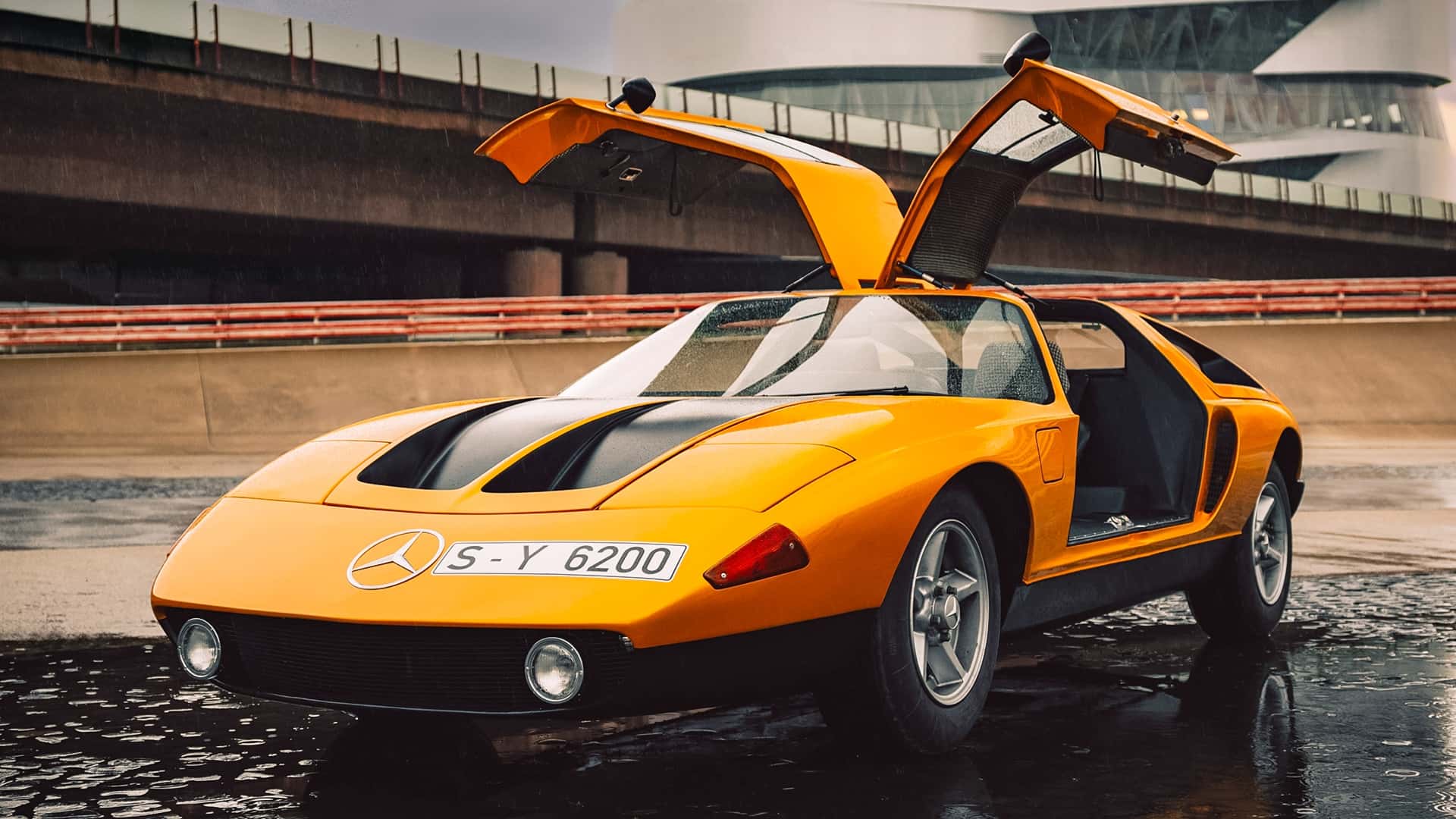
After nearly six decades behind the doors of the Mercedes-Benz collection, the extraordinary 1970 C 111-II Car 33 is finally being offered to a private buyer. Powered by a four-rotor Wankel engine and capable of reaching 300 km/h, the experimental supercar will go under the hammer at the Palais du Louvre in February 2027, with a reported value in excess of €25 million.
There are cars that become valuable because they are rare, and there are cars whose importance goes far beyond the number of examples ever built. The Mercedes-Benz C 111 belongs firmly in the second category. A radical experiment in design, engineering and performance, it was conceived at a time when the future of the automobile seemed open to extraordinary possibilities. Its striking proportions, gullwing doors and unconventional rotary powertrain made it one of the most intriguing automotive creations of its generation. Yet, despite enormous public fascination, it never became a production car.
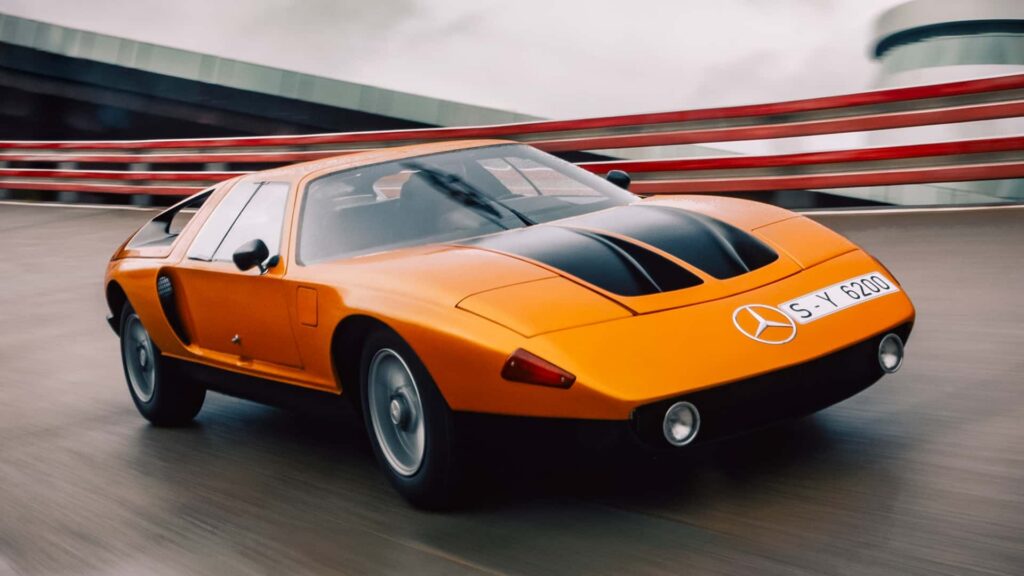
Now, more than half a century after its creation, one of the most significant examples is preparing to leave the manufacturer’s collection. Mercedes-Benz has confirmed that its 1970 C 111-II, internally identified as Car 33, will be offered at auction by RM Sotheby’s on 3 February 2027 at the Palais du Louvre in Paris, during Rétromobile Paris. It marks the first time in the company’s history that a C 111 has been offered for public sale.
The announcement carries an additional significance for collectors: Mercedes-Benz has committed not to sell another C 111 for at least 25 years. In other words, this is not simply the appearance of a rare classic at a prestigious auction. It is an opportunity to acquire a vehicle that has remained beyond the reach of private collectors for almost six decades.
A Supercar That Was Never Meant to Be Ordinary
The story of the C 111 began in the late 1960s, when Mercedes-Benz was exploring how advanced engineering could shape the next generation of high-performance automobiles. The company wanted a vehicle that could demonstrate new technology while offering a glimpse of what a future Mercedes sports car might look like.
The original C 111 made its public debut at the International Motor Show in Frankfurt in September 1969. Its appearance was a dramatic departure from the more restrained Mercedes-Benz styling familiar at the time. A low nose, wedge-shaped body, dramatic rear proportions and gullwing doors gave it the presence of a machine designed for another decade.
Its doors recalled the legendary Mercedes-Benz 300 SL, but the C 111 was not simply a nostalgic tribute. It was a technological experiment in its own right. The body used glass-fibre-reinforced plastic, while the engine was positioned behind the driver and ahead of the rear axle. The combination of lightweight construction, aerodynamic thinking and an unusual powertrain gave the car a distinctly futuristic character.
The public response was extraordinary. The C 111 attracted attention at motor shows and generated intense interest among enthusiasts. According to Mercedes-Benz, prospective buyers were so eager to own one that some reportedly sent blank cheques to Stuttgart. The company, however, did not turn that enthusiasm into a production programme.
That decision is central to the car’s mystique today. The C 111 became a symbol of what Mercedes-Benz was capable of imagining, rather than a model customers could simply order.
The C 111-II: A More Developed Vision
The car heading to auction is not the original 1969 prototype. It is a C 111-II, the more developed version presented at the Geneva Motor Show in 1970.
The second-generation design refined the original concept. Mercedes-Benz revised the bodywork, improved visibility and developed the exterior into a more cohesive aerodynamic shape. The result retained the dramatic wedge profile but gave the car a more finished and purposeful appearance.
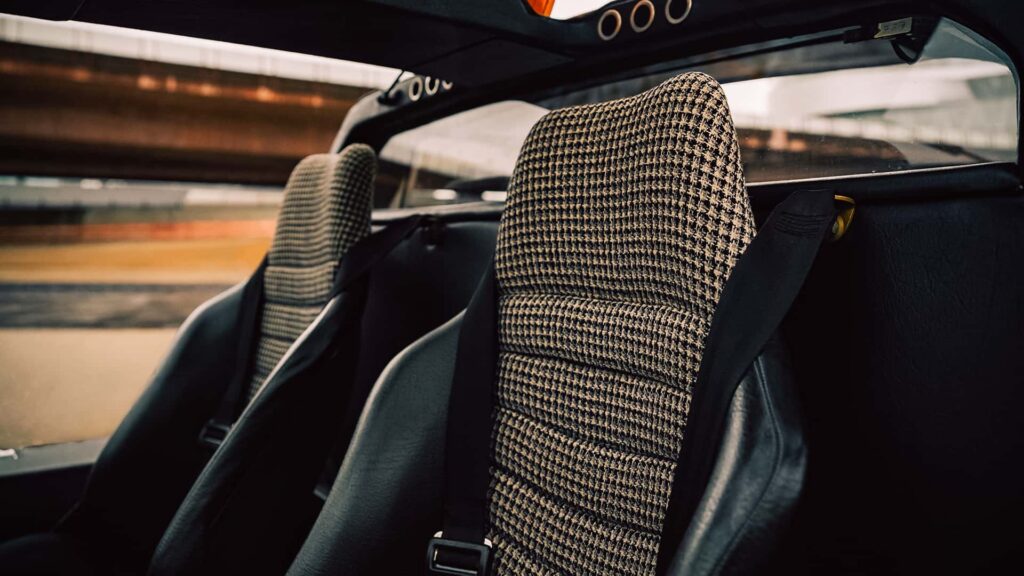
Its distinctive paint finish, known as Weißherbst, became closely associated with the C 111. The warm, pale orange tone gave the experimental vehicle a visual identity that was difficult to confuse with anything else on the road. The cabin was equally individual, featuring grey-and-white houndstooth-pattern upholstery, sports seats, a four-spoke steering wheel and a vertically mounted Becker Europa radio.
The interior is particularly interesting because it demonstrates how seriously Mercedes-Benz approached the project. This was not an empty styling exercise or a decorative concept car. The C 111-II had a fully developed cabin, practical equipment and the kind of details expected in a functioning road vehicle.
The company was exploring the possibility of a genuine high-performance automobile, even if the final decision would ultimately prevent it from reaching customers.
The Four-Rotor Wankel Engine: The Technology That Made It Different
The most extraordinary feature of Car 33 sits behind the passenger compartment.
Rather than using a conventional piston engine, the C 111-II was equipped with a 2.4-litre, four-rotor Wankel rotary engine. Identified as the M 950 W 48, the unit was installed in August 1970 and developed by Mercedes-Benz as part of its wider investigation into rotary-engine technology.
The difference between a rotary engine and a conventional piston engine is fundamental. In a traditional internal-combustion engine, pistons move up and down inside cylinders to complete the combustion cycle. A Wankel engine instead uses rotating triangular-shaped rotors inside specially shaped housings. This arrangement performs the intake, compression, combustion and exhaust processes without the conventional piston-and-valve mechanism.
The appeal was considerable. A rotary engine could be compact, relatively light and capable of delivering power smoothly at high engine speeds. For a manufacturer developing an experimental sports car, those characteristics offered an intriguing alternative to traditional engine architecture.
The C 111-II’s four-rotor configuration took that idea further. The auction catalogue describes the engine as producing 350 horsepower, while Mercedes-Benz’s US media release lists 345 hp, equivalent to 257 kW. These figures reflect the different horsepower conventions used in the published specifications; the car’s performance credentials remain remarkable for its period.
The engine is paired with a five-speed ZF manual transaxle. According to the auction catalogue, the car has a redline of 9,000 rpm, accelerates from zero to 100 km/h in 4.8 seconds and can reach a maximum speed of 300 km/h.
Those figures placed the C 111-II among the most ambitious high-performance machines of its era. Its relatively low weight of approximately 1,240 kilograms also helped the engineers make the most of the available power.
The rotary engine was not merely an unusual technical detail. It was the heart of the C 111 experiment, representing Mercedes-Benz’s belief that an alternative form of combustion technology could have a serious future in high-performance motoring.
Why Mercedes-Benz Never Put the C 111 Into Production
For all its promise, the C 111 never became a showroom model. In November 1971, Mercedes-Benz decided against series production.
The reasons were more complicated than a simple lack of interest. The rotary engine offered impressive performance and compact packaging, but it also presented challenges involving fuel consumption, durability and emissions. Changing regulatory requirements, particularly in the United States, created further obstacles.
The company faced a difficult engineering question: could the rotary powertrain be developed sufficiently to meet future requirements without undermining the entire concept?
There were also commercial considerations. Bringing an experimental supercar into production would have required significant investment, while the oil crisis of the early 1970s changed the industry’s priorities and placed greater emphasis on efficiency.
The C 111’s architecture was closely connected to its compact rotary engine. Replacing it with a conventional powertrain would have required substantial changes to the vehicle’s engineering and packaging.
The decision to stop the production project left the C 111 in an unusual position. It was developed far beyond the typical styling concept, yet it was never offered to customers. It remained an engineering achievement without becoming a commercial model.
That unfinished story is one reason the C 111 continues to fascinate collectors. It represents a possible future that Mercedes-Benz explored but ultimately chose not to pursue.
Car 33: The Specific Example Going Under the Hammer
The car selected for the auction is the third C 111-II built, known within the Mercedes-Benz collection as Car 33. Its internal number is an identification used by the company rather than a reference to a production model designation.
Its construction began in March 1970. The vehicle passed through different stages of assembly and body completion before receiving its four-rotor Wankel engine in August of that year. It then joined Mercedes-Benz’s experimental fleet under the registration S-Y 6200.
Car 33 was not simply stored away as a future museum exhibit. It was used for actual engineering work.
Among its assignments was testing the fluidic system designed to help the two side-mounted fuel tanks empty evenly. Together, the tanks held approximately 116 litres of fuel. The vehicle was also used for temperature measurements in the rear luggage compartment and for test drives at the Hockenheimring.
One particularly unusual episode involved the practical question of how hot the luggage compartment became during driving. The auction history describes an experiment associated with Mercedes-Benz engineer Rudolf Uhlenhaut, in which butter was placed in the luggage area to assess whether temperatures remained within acceptable limits. The anecdote has since become a memorable detail in the car’s history: even an experimental supercar had to demonstrate that its practical features worked.
The vehicle also participated in testing related to anti-lock braking technology. Its ABS function is no longer active today, but the testing illustrates how the C 111 programme contributed to broader engineering development.
Car 33 subsequently became one of the best-known examples of the project. It was featured in the first issue of the German edition of Playboy in 1972 and was presented to celebrated conductor Herbert von Karajan, who had an opportunity to experience the C 111 project.
In 1975, the car entered the company’s vehicle collection. When the Mercedes-Benz Museum opened in 2006, Car 33 became part of its Fascination of Design exhibition, where it remained a prominent display vehicle.
A Careful Restoration That Preserved Its History
Car 33 underwent recommissioning in 2024 at the Mercedes-Benz Classic Center in Fellbach. The work returned the vehicle to roadworthy condition in preparation for its appearance at the Pebble Beach Concours d’Elegance that year.
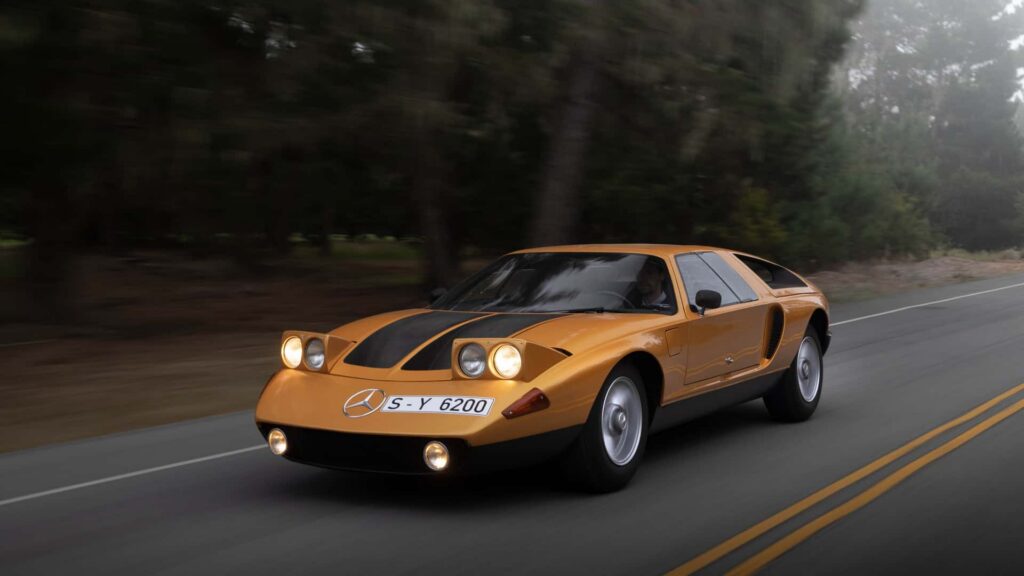
Importantly, the restoration did not attempt to make the car look as though it had just left the factory. Mercedes-Benz deliberately preserved the original patina of the exterior and interior, maintaining the marks of time that form part of the vehicle’s history.
The drivetrain received extensive attention, and a fire-extinguishing system was installed in the engine compartment. The approach reflects a growing appreciation among serious collectors for preservation that respects originality rather than automatically replacing every aged surface.
At the time of the October 2026 photography session, the odometer showed 24,766 kilometres.
The auction will also include the car’s original-style road wheels and an additional set of wider magnesium wheels associated with its historical testing use. Mercedes-Benz notes that the magnesium wheels are now suitable for display only because of their age and condition.
For a collector, these details matter. The value of a historically significant automobile is not determined only by its appearance or performance. Its documented history, originality, provenance and relationship to the manufacturer’s own development programme can be equally important.
From Experimental Supercar to a New Collector Opportunity
The C 111 has always occupied an unusual place in the Mercedes-Benz story. It was not a production model, yet it became one of the brand’s most recognisable experimental vehicles. Its design and engineering ambitions gave it an influence that extended beyond the small number of prototypes produced.
Mercedes-Benz states that only 17 C 111 vehicles were built across the programme, with 13 surviving examples remaining in the company’s collection before this sale. The auction therefore represents a major change in the history of the project: a car that was previously available only to view in the manufacturer’s care is finally entering the private collector market.
The significance is also reflected in the auction’s positioning. RM Sotheby’s currently lists the 1970 C 111-II at a value in excess of €25 million. That is a substantial figure, but the car’s importance is not based on rarity alone. It combines factory provenance, an original four-rotor engine, a documented development history, unusual technical specification and a level of access that has never previously been available to private buyers.
For context, RM Sotheby’s has previously worked with Mercedes-Benz on landmark sales, including the 1955 Mercedes-Benz 300 SLR Uhlenhaut Coupé, which achieved €135 million in 2022, and the W 196 R Streamliner, sold for €51,155,000 in 2025. Those results demonstrate the extraordinary interest that can surround historically important Mercedes-Benz competition and heritage vehicles, although they should not be treated as direct price comparisons for the C 111.
The C 111 has its own identity and its own place in automotive history. Its significance comes from a different combination of experimental engineering, design ambition and long-standing exclusivity.
Why the Auction Is Taking Place at the Louvre
The sale is scheduled for 3 February 2027 at the Salles du Carrousel within the Palais du Louvre in Paris. It will take place during Rétromobile Paris, one of the major international gatherings devoted to historic automobiles.
The setting adds an appropriately distinguished backdrop to a vehicle that has spent much of its existence as a museum and heritage object. The auction will be handled by RM Sotheby’s, with bidding available in person or by telephone following the required registration process. The auction house’s listing provides further information about the vehicle and participation.
The timing also places the sale in front of an international audience of collectors, dealers and enthusiasts already travelling to Paris for the classic-car event.
For prospective buyers, the opportunity is particularly unusual because Mercedes-Benz has contractually committed not to sell another C 111 for at least 25 years. The restriction gives this sale a significance that extends beyond the individual vehicle: it is the only announced opportunity to acquire one from the manufacturer for a generation.
Where the Auction Proceeds Will Go
The decision to sell Car 33 is also connected to the future of the Mercedes-Benz Museum in Stuttgart.
Mercedes-Benz has confirmed that the proceeds will support its Mercedes-Benz Museum 2.0 project. The initiative is intended to develop the museum further and expand its accessibility through digital experiences.
A central part of the plan is the creation of a digital twin, allowing people around the world to explore museum exhibits interactively. Mercedes-Benz has indicated that the first results are expected to become visible in 2027.
This gives the auction a purpose beyond the transfer of a rare automobile into private ownership. The company is using an exceptional piece of its heritage to help finance the next stage of how that heritage will be presented to future generations.
It is a notable decision: a car that once represented the future of automotive engineering will now help shape the future of the institution that preserves the company’s history.
The C 111’s Legacy: A Future That Never Quite Arrived
Although the rotary-powered C 111-II never entered production, the wider programme continued to produce important engineering work.
Mercedes-Benz later developed diesel-powered C 111 variants for high-speed record attempts. In 1976, the C 111-II D, equipped with a five-cylinder turbodiesel engine, set 16 records, including three world records. The C 111-III followed in 1978 with further record-setting ambitions.
The programme reached another extraordinary point with the C 111-IV in 1979. Powered by a twin-turbocharged V8, it achieved a reported 403.978 km/h on the Nardò high-speed circuit in Italy, setting a circuit record.
These later developments demonstrate that the C 111 was never simply a styling experiment. It became a platform through which Mercedes-Benz investigated aerodynamics, powertrain technology, high-speed stability and performance engineering.
Its influence can also be seen in more recent design studies. The Mercedes-Benz Vision One-Eleven, presented in 2023, revisited the C 111’s visual language through its proportions, gullwing doors and distinctive colour references. The newer concept uses electric propulsion rather than a rotary engine, but the relationship between the two vehicles is unmistakable.
That connection is particularly revealing. The technologies have changed, yet the original C 111 still provides a source of inspiration for how Mercedes-Benz imagines its future.
Readers following the evolution of modern performance and luxury engineering can also explore our coverage of the Sanrivatti One hypercar and its naturally aspirated V10, the McLaren McL 6GT and its return to a manual gearbox, and BMW’s anticipated 2027 luxury car developments. Each reflects a different approach to the question of what makes a high-performance car distinctive.
A Once-in-a-Generation Moment for Automotive Collectors
The Mercedes-Benz C 111-II Car 33 is not being offered as a newly developed supercar, nor is it a forgotten production model returning to public attention. It is a surviving piece of the company’s engineering history, preserved in its original character and now being released from a collection that has protected it for almost six decades.
Its four-rotor Wankel engine represents an era of experimentation. Its gullwing silhouette captures a moment when automotive design was moving towards a more dramatic future. Its development history connects it to some of Mercedes-Benz’s most ambitious engineers, while its long museum life gives it a provenance that few privately owned classics could match.
The February 2027 auction will therefore be watched for more than its final hammer price. It will mark the moment a car that was once considered unobtainable becomes available to a private collector.
For the successful bidder, the reward will be more than ownership of a rare Mercedes-Benz. It will be the responsibility of holding a remarkable chapter of automotive history — one that the manufacturer itself has kept close for nearly 60 years.
The C 111 was built to explore what might be possible. Its first public sale now makes possible something that generations of collectors could only imagine.
Frequently Asked Questions
Q1. What is the Mercedes-Benz C 111?
A: The Mercedes-Benz C 111 is an experimental supercar developed in the late 1960s to explore advanced design, lightweight construction and alternative engine technology. It never entered series production.
Q2. When will the Mercedes-Benz C 111-II Car 33 be auctioned?
A: The car is scheduled to be auctioned on 3 February 2027 at the Palais du Louvre in Paris, during Rétromobile Paris.
Q3. Which auction house is selling the Mercedes-Benz C 111?
A: RM Sotheby’s has been appointed to conduct the auction.
Q4. What makes this Mercedes-Benz C 111 auction historic?
A: It is the first time Mercedes-Benz has offered a C 111 for public sale. The company has also committed not to sell another example for at least 25 years.
Q5. What engine does the 1970 Mercedes-Benz C 111-II have?
A: Car 33 is powered by an original 2.4-litre, four-rotor M 950 W 48 Wankel rotary engine. The auction catalogue lists its output at 350 horsepower.
Q6. How fast is the Mercedes-Benz C 111-II?
A: The C 111-II has a reported top speed of 300 km/h (186 mph) and can accelerate from 0 to 100 km/h in approximately 4.8 seconds.
Q7. How many Mercedes-Benz C 111 cars were built?
A: Mercedes-Benz states that 17 C 111 vehicles were built across the programme. Thirteen surviving examples remained in the manufacturer’s collection before the announced sale.
Q8. What is the estimated value of the Mercedes-Benz C 111-II?
A: RM Sotheby’s currently lists the car at a value in excess of €25 million. The final auction result will depend on bidding.
Q9. Why was the Mercedes-Benz C 111 never produced commercially?
A: Challenges involving rotary-engine fuel consumption, durability and emissions, alongside regulatory changes, production costs and the oil crisis, contributed to the decision not to proceed with series production.
Q10. What happened to Car 33 after its development work?
A: It joined the Mercedes-Benz vehicle collection in 1975 and became part of the Mercedes-Benz Museum’s Fascination of Design exhibition when the museum opened in 2006.
Q11. Was the Mercedes-Benz C 111-II restored?
A: Yes. The Mercedes-Benz Classic Center recommissioned Car 33 in 2024, returning it to roadworthy condition while deliberately preserving the original patina of its exterior and interior.
Q12. Where will the proceeds from the C 111 auction go?
A: Mercedes-Benz will direct the proceeds towards the Mercedes-Benz Museum 2.0 project in Stuttgart, including plans to make the museum’s collection more accessible through digital experiences.
Mercedes-Benz C 111-II Car 33 – Key Details
| Category | Details |
|---|---|
| Manufacturer | Mercedes-Benz |
| Model | C 111-II |
| Year | 1970 |
| Vehicle | Car 33 |
| Engine | 2.4-litre four-rotor Wankel rotary |
| Engine Type | M 950 W 48 |
| Power | 350 hp (auction catalogue); Mercedes-Benz US release lists 345 hp |
| Transmission | Five-speed ZF manual transaxle |
| Top Speed | 300 km/h (186 mph) |
| 0–100 km/h | 4.8 seconds |
| Weight | Approximately 1,240 kg |
| Exterior Colour | Weißherbst |
| Interior | Grey-and-white houndstooth-pattern upholstery |
| Auction Date | 3 February 2027 |
| Auction Location | Palais du Louvre, Paris, France |
| Auction House | RM Sotheby’s |
| Published Value | In excess of €25 million |
| Restoration / Recommissioning | Mercedes-Benz Classic Center, 2024 |
| Odometer | 24,766 km at October 2026 photography |
| Auction Proceeds | Mercedes-Benz Museum 2.0 project |
Editorial note: Auction details and technical specifications are based on the Mercedes-Benz announcement and RM Sotheby’s catalogue available at the time of publication. The final auction result has not yet been determined.