From a Paris Trunk Workshop in 1854 to Pharrell Williams’ Runway Spectacles, How One Obsession With Travel Built a Global Language of Luxury.
The Louis Vuitton luxury house began as a workshop that built trunks for people who could afford to cross continents and oceans in comfort. Founded in Paris in 1854 by Louis Vuitton, it sold one practical promise: your belongings would arrive intact, and they would arrive in style. More than 170 years later, that promise has grown into one of the most powerful names in luxury, carried by bags such as the Speedy, Alma, Neverfull and Keepall, by artist collaborations and by runway shows staged at the Louvre and on the Pont-Neuf.
This guide follows the story of the Louis Vuitton luxury house from its first flat-topped trunk to the creative leadership of Nicolas Ghesquière and Pharrell Williams. It explains why the Monogram became so recognizable, how everyday handbags grew out of travel luggage, and how to choose a piece that suits the way you actually live. Along the way, it shows why one idea, travel, remains the thread the house keeps returning to.
Key Takeaways
- Founded in Paris in 1854, the house began as a trunk maker and built its name on protecting travelers’ belongings.
- The Monogram, designed in 1896, became one of the world’s most recognizable patterns.
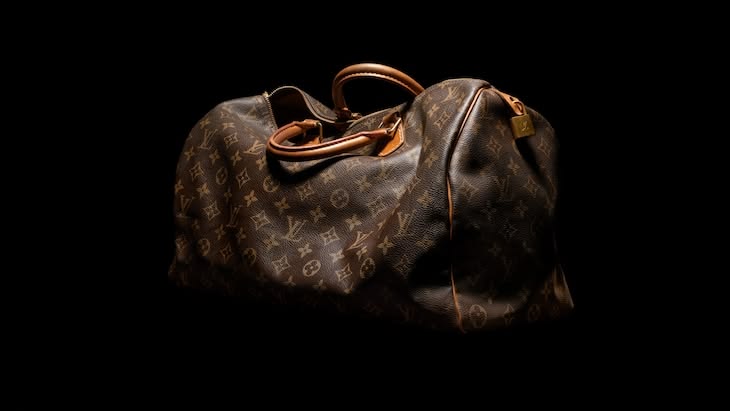
- The Speedy, Alma, Neverfull and Keepall carry the spirit of travel into everyday life.
- Marc Jacobs, Nicolas Ghesquière and Pharrell Williams each pushed the brand deeper into fashion and culture.
The Louis Vuitton Luxury House at a Glance
The Louis Vuitton luxury house has changed enormously since 1854, yet its milestones follow a clear pattern: a practical invention, a protective signature, a move into everyday objects and then a series of creative leaders who pushed the brand into fashion and culture. The table gives the quick version before we look at each chapter.
| Year | Milestone |
|---|---|
| 1854 | Louis Vuitton opens his trunk-making workshop in Paris |
| 1858 | Flat-lid trunk in gray Trianon canvas introduced |
| 1896 | Georges Vuitton designs the Monogram canvas |
| 1930s | Express bag (later the Speedy) created; Alma’s forerunner appears, in wider production by 1934 |
| 1997 | Marc Jacobs appointed artistic director; ready-to-wear launched |
| 2001 | Stephen Sprouse graffiti collaboration |
| 2003 | Takashi Murakami Multicolore collaboration |
| 2013 | Nicolas Ghesquière takes over the women’s collections |
| 2023 | Pharrell Williams named artistic director of the men’s collections |
Read in order, the timeline shows a house that moved from solving a practical problem to defining a style.
How the Louis Vuitton Luxury House Began as a Trunk Maker
A Workshop Built for Wealthy Travelers
Louis Vuitton did not begin as a fashion designer. When he opened his workshop on rue Neuve-des-Capucines in 1854, he was a trunk maker, a craftsman who designed, built and packed luggage for wealthy travelers. Nineteenth-century journeys were hard on belongings: trunks were thrown onto stagecoaches, hauled onto trains, stacked in the holds of ocean liners and sometimes stolen along the way. The early Louis Vuitton luxury house placed itself exactly where that technical challenge met a growing appetite for refinement, and it built its reputation on solving the problem elegantly.
The 1858 Flat-Top Trunk
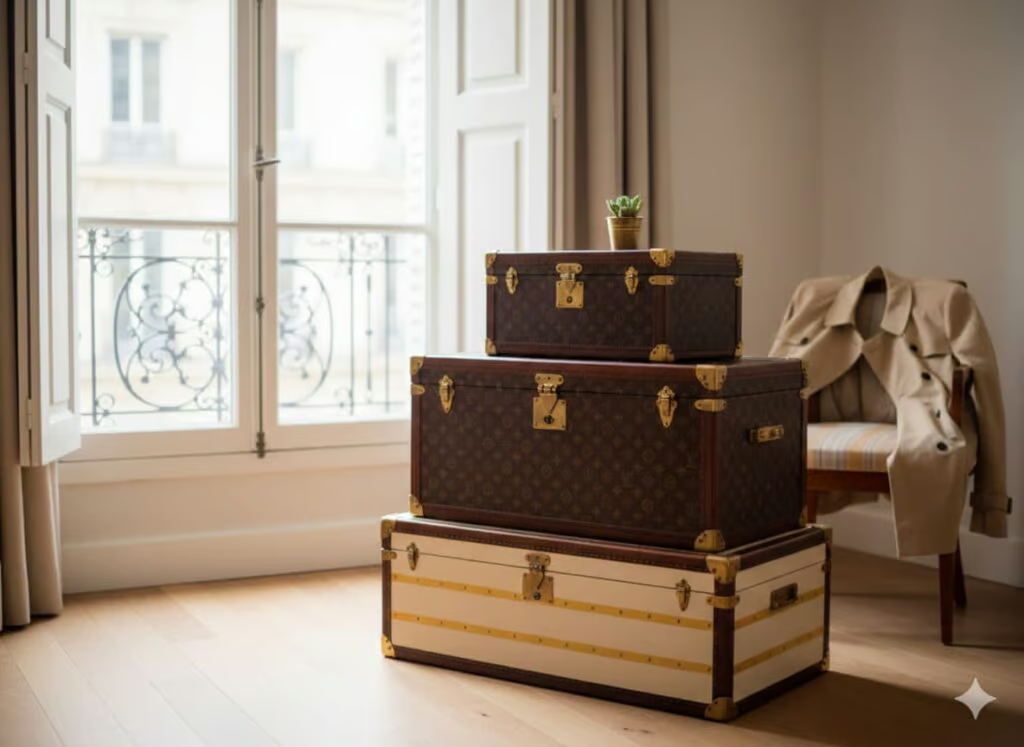
In 1858, Vuitton introduced the innovation that changed luggage: a trunk with a flat lid, covered in gray Trianon canvas. Traditional trunks were domed so rainwater would run off, but a flat top meant they could be stacked, a decisive advantage in the age of long-distance rail and sea travel. The design made two promises at once. Functionally, it offered lighter weight, water resistance and sturdiness. Aesthetically, it offered clean lines and careful finishing, from the locks and fittings to the handles. Behind this seemingly simple box sat a philosophy that still defines the Louis Vuitton luxury house: technology treated as an object of desire.
Travel as the House’s DNA
Very quickly, the trunks became part of the wardrobe of the era’s travelers, from grand ocean-liner voyages and artist tours to expeditions and the journeys of crowned heads. The name came to stand for travel that was elegant, organized and under control. That theme has never left. It reappears in modern campaigns, runway sets, collaborations and even fragrance advertising, which is why travel is so often described as the real signature of the brand.
The Monogram: A Signature Built to Beat Counterfeiters
Georges Vuitton and the 1896 Design
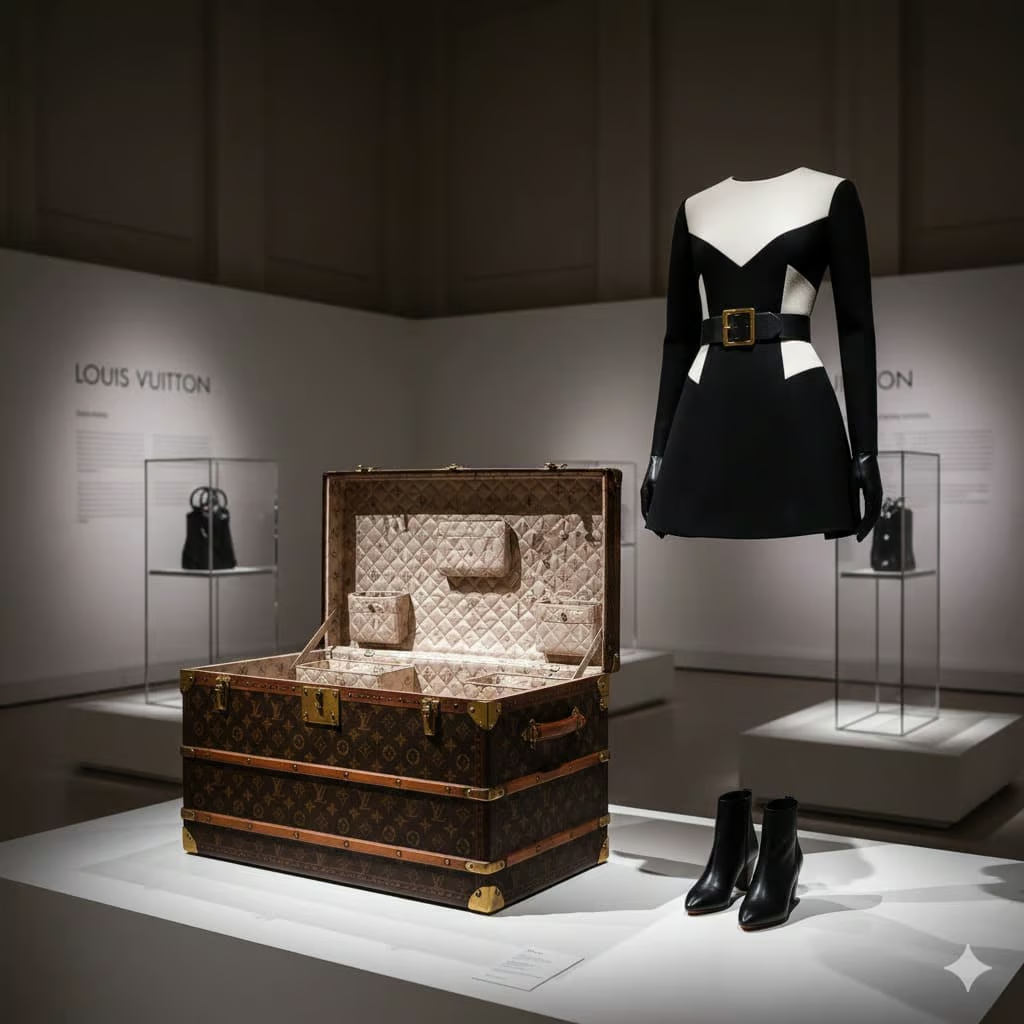
Success invites imitation. To fight counterfeiting, Georges Vuitton, Louis’s son, set out to create a visual signature that would be hard to copy. After trying a beige and brown striped canvas and then a checkerboard pattern, he designed the LV Monogram in 1896: interlocking letters, stylized flowers and rosettes. The motif made every trunk instantly recognizable, signaled durability and prestige, and shifted the brand into a world of symbols rather than pure function. It has since become one of the most famous patterns on earth, adored, criticized, remixed and borrowed, but never ignored.
What the Monogram Says Today
Today the Monogram works as a compact promise: innovation through the flat trunk and technical luggage, travel as the natural horizon, durability through coated canvas and hardware, and French craftsmanship and heritage. It is also a creative battleground. Stephen Sprouse’s graffiti, Takashi Murakami’s multicolored version and Yayoi Kusama’s polka dots have turned the pattern into a testing ground where art and fashion answer each other. That flexibility explains how the Louis Vuitton luxury house keeps a design more than 130 years old feeling current, because each reinvention adds a new layer of meaning without erasing the original.
From Trunks to Everyday Bags
For decades, the house stayed focused on luggage and trunks. The move into everyday bags came gradually, as it began to shrink the spirit of travel into pieces designed for city life. The idea was simple: the luxury of a journey could be worn every day, and a handbag could act as a personal, miniature trunk.
Alma and Speedy: Travel in Miniature
In the 1930s, the forerunner of the Alma appeared under the name Squire. As the story goes, it was renamed at the request of Gabrielle Chanel, who ordered one, and it entered wider production in 1934. Around 1930, the Express bag was also created as a reduced version of the Keepall travel bags, and it later became the Speedy. Both designs carried the same message: everyday life deserves the care once reserved for the voyage.
Creative Directors Who Shaped the Louis Vuitton Luxury House
Three appointments in particular reshaped the story of the Louis Vuitton luxury house, and each one pulled the brand further from its workshop origins into the center of fashion and pop culture.
Marc Jacobs: Ready-to-Wear and the Collaboration Era
In 1997, the house made a decisive strategic choice: it appointed Marc Jacobs as a dedicated artistic director and launched women’s ready-to-wear, followed by men’s. Jacobs placed the brand on the fashion calendar, multiplied artistic collaborations with names such as Stephen Sprouse, Takashi Murakami, Richard Prince and Yayoi Kusama, and turned the Monogram into a playground of graffiti, bright colors, cherries and pandas. His spectacular shows and cult bags, including reinterpretations of the Speedy, moved the company from brilliant trunk maker to global fashion house.
Nicolas Ghesquière: A Future Built on the Archive
Nicolas Ghesquière has led the women’s collections since 2013, and his contract was reportedly extended in 2024 for another five years, a sign of confidence from LVMH. His style pairs futuristic silhouettes and sculpted volumes with technical materials and historical references, and his structured bags often draw on trunk design, as in the Petite Malle, City Steamer and Twist. Through his work, the Louis Vuitton luxury house has gained a recognizable Louis Vuitton woman who is mobile, urban and sometimes almost science-fiction, yet always anchored to the heritage of trunks, Monogram and travel.
Pharrell Williams: Street Culture on a Global Stage
In February 2023, Pharrell Williams was named artistic director of the men’s collections, a surprise that deepened the cultural reach of the Louis Vuitton luxury house. His collections blend tailoring, hip-hop and skate references, house archives and nods to the brand’s own codes, from hats and colors to patterns. His shows, staged as events with strong musical and visual identities, such as the one on the Pont-Neuf, aim to make the brand a global cultural platform rather than only a fashion label. Creative handovers are a recurring theme across luxury, as seen when Seán McGirr left Alexander McQueen after three years as creative director.
Iconic Louis Vuitton Bags Compared
Four bags carry most of the brand’s everyday identity. The table compares their origins, defining features and best uses.
| Bag | Origin | Key Features | Best For |
|---|---|---|---|
| Speedy | Derived from the 1930s Express bag | Rounded bowling shape, leather handles, sizes 25 to 40 | An everyday companion |
| Alma | 1930s Squire, wider production in 1934 | Structured, oval base, double zipper, short handles | Dressier looks |
| Neverfull | Launched in the 2000s | Large tote, side laces to adjust volume, removable inner pocket on recent versions | Daily carry and travel |
| Keepall | Soft-sided travel bag | Monogram or Damier canvas, sizes 45 to 60, leather handles | Quick weekend trips |
The Speedy remains the most recognizable of the group, a pop icon whose Monogram 30 version has been seen on countless arms and whose Murakami and Sprouse editions sit at the center of the Y2K revival. The Alma, named after the Place de l’Alma in Paris, offers a more classic elegance. Its Monogram Graffiti edition, from the Jacobs and Sprouse collaboration, has become a prized vintage piece and recently reappeared on Rihanna’s arm. For more moments like that, browse our Celebrity News section.
The Neverfull, launched in the 2000s, is the practical tote that became an urban uniform, seen in subways, airports and offices. The Keepall carries the trunk spirit into a 48-hour format for people who live between flights and trains. Together, the four show how the Louis Vuitton luxury house turned travel gear into daily style.
Art in the Monogram: Louis Vuitton Collaborations
If the Monogram is the signature, collaborations are the experiments. Each major partnership asked a different question about what a luxury pattern can be.
Stephen Sprouse’s Graffiti (2001)
In 2001, Marc Jacobs invited Stephen Sprouse to cover the Monogram in fluorescent graffiti, scrawling words such as “Louis Vuitton,” “Speedy” and “Keepall” across the canvas. The Alma Graffiti became a symbol of the era, a clash between luxury’s most coded motif and street writing, and it opened the door to a long series of dialogues with pop culture.
Takashi Murakami’s Multicolore (2003)
The 2003 collaboration with Takashi Murakami was a historic turning point, bringing a multicolored Monogram, smiling cherries, pandas and kawaii motifs to LV canvas. The Multicolore line is reported to have generated more than $300 million in a single year, and it cemented the idea that the Monogram is as much a medium for art as a logo.
Kusama, Koons and Beyond
Yayoi Kusama brought her infinite polka dots, and Jeff Koons put reproductions of masterpieces on bags, with many capsules from designers, artists and labels following. Each project strengthens the position of the Louis Vuitton luxury house as a platform between art and fashion, capable of turning a bag into a collector’s item and a historic motif into a contemporary canvas.
Where the Louis Vuitton Luxury House Stands Today
The Flagship of LVMH
The Louis Vuitton luxury house is the flagship of LVMH, with fashion and leather goods revenue estimated in the tens of billions of euros. Under Pietro Beccari, formerly the chief executive of Dior, it keeps widening its territory through new flagship stores, a push into watchmaking and jewelry, and a growing lifestyle universe of books and objects. Dior is the house behind the ice-blue gown Taylor Swift wore to the Academy Museum Gala, and readers following the category can find more in our Luxury Watches and Luxury Jewellery coverage.
Beauty as the Next Frontier
Already present in perfumery, the brand has been preparing a complete makeup line of lipsticks, eyeshadows and balms under the artistic direction of Pat McGrath, planned for autumn 2025. The positioning is ultra-luxurious packaging, distribution through Louis Vuitton boutiques and a strong link to leather goods through dedicated cases and pouches. The move shows how the Louis Vuitton luxury house increasingly wants to be a world rather than simply a fashion player. For wider industry coverage, see our Fashion & Beauty section.
Runway Events at the Louvre and Pont-Neuf
The shows have become spectacles: catwalks inspired by stacked trunks, and presentations in the Cour Carrée of the Louvre, on the Pont-Neuf and before monumental installations. Their message is consistent. The house keeps returning to its imaginary of travel and architecture, with trunks, bridges, squares and monuments, and projects it into the present.
How to Choose a Piece From the Louis Vuitton Luxury House
Start with the entry point. A bag is the obvious door, but luggage such as a cabin suitcase, a Keepall or a mini trunk reconnects you with the original DNA, and small leather goods such as card holders, wallets and cases offer a way into the Monogram universe without buying a bag.
| Option | Advantage | Trade-Off |
|---|---|---|
| Classic icon (Speedy, Neverfull, Alma or Keepall in Monogram or Damier, permanent colors) | Easier to wear, simpler to resell, less tied to trends | Less distinctive |
| Collaboration piece (Murakami, Sprouse, Kusama) | Potentially sought after on the secondary market; reflects the art and fashion of its time | Riskier and tied to a moment |
Before buying, ask three questions. How often will I really carry it? Will I still like it in ten years, and is it something I might pass on? What does it say about me? A Neverfull Monogram suggests practicality and global status, a glossy, quiet Alma hints at knowledge of the codes, and a Speedy Murakami or Sprouse speaks of Y2K archives and pop culture. Whichever you choose, the best purchase from the Louis Vuitton luxury house is the one that fits how you actually live.
Why Travel Still Defines the Louis Vuitton Luxury House
What sets the Louis Vuitton luxury house apart is the consistency of one theme. From the flat trunk of 1858 to runway shows on historic bridges, from Keepall bags to mini-trunk handbags, everything circles one question: how do you carry your life, your objects and your references through a world that never stops moving? The Monogram, the bags, the collaborations and the Pharrell Williams shows all belong to the same story, that of a house that understood early that luxury in the twenty-first century is as much about mobility as ownership. Luxury is no longer just what you keep at home, but what you carry with you, physically, culturally and symbolically. Explore more in our Latest Stories.
FAQs: Louis Vuitton Luxury House
When Was the Louis Vuitton Luxury House Founded?
Louis Vuitton founded the company in Paris in 1854, opening a trunk-making workshop on rue Neuve-des-Capucines.
Why Was the Monogram Created?
Georges Vuitton designed the Monogram in 1896 to create a signature that was hard to counterfeit, using interlocking LV letters, stylized flowers and rosettes.
Who Designs for Louis Vuitton Today?
Nicolas Ghesquière has led the women’s collections since 2013, and Pharrell Williams has been artistic director of the men’s collections since February 2023.
What Defines the Louis Vuitton Luxury House Today?
A consistent focus on travel, expressed through trunks, the Monogram, the Speedy, Alma, Neverfull and Keepall, art collaborations and spectacular runway events.
Sources: Louis Vuitton